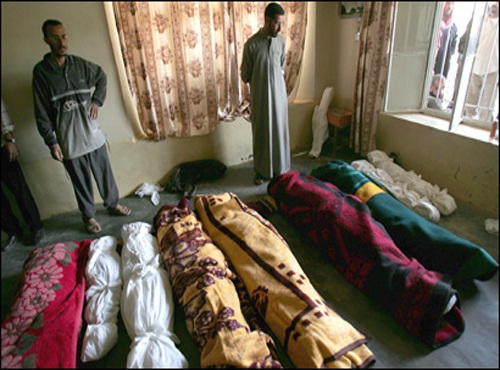
Several analysts said they feared that the deal Monday to end Marine Staff Sgt. Frank Wuterich’s court-martial in the killing of 24 Iraqis would harden the widespread conviction in the international community that the U.S. does not hold its troops accountable for misdeeds or meet the standards of conduct it attempts to impose on other countries.
“This is only going to reinforce that sense,” said Sarah Leah Whitson, executive director of the Middle East and North Africa division of Human Rights Watch, which seeks to curtail inhumane conduct in war. “This has contributed significantly to the cynicisms of people in the region about America’s rhetoric — about America standing for principles. When push comes to shove, when it comes to looking at the misconduct of their own soldiers, there is no accountability.”
Wuterich will plead guilty to a single count of negligent dereliction of duty, with a maximum sentence of three months in the brig. Other charges were dropped. Wuterich, 31, was accused of manslaughter, assault and dereliction of duty for allegedly leading his squad on a bloody rampage on the morning of Nov. 19, 2005, after a roadside bomb killed one Marine and injured two in the Euphrates River town of Haditha. Twenty-four unarmed Iraqis died.
One former Marine prosecutor said the Haditha case would be studied by future generations of military lawyers as an example of how not to investigate and prosecute suspected war crimes.
Amos Guiora, a University of Utah law professor and former career legal officer with the Israeli Defense Forces, agreed that the plea deal “creates a greater perception that the misconduct of American soldiers goes largely unpunished by the United States.”
“It’s going to be hard to explain to the world that at the end of the day this fellow will serve three months and that the charges have been so significantly reduced,” Guiora said.
Guiora called incidents like the Haditha killings and the abuse of foreign captives at Iraq’s Abu Ghraib prison “festering wounds” that undermine host country support for U.S. military operations abroad and place American soldiers at greater risk of insurgent attacks.
“This is why it is going to be very important to ensure that the world understands that behind this were legal limitations, evidentiary limitations, and not policy to let Americans off scot free,” said Guiora.
There was no immediate reaction from inside Iraq, where the Haditha case, like other notorious instances of civilian deaths at the hands of U.S. troops or contractors, had come to symbolize what many Iraqis viewed as the impunity of American forces. Resentment about Haditha and other cases of civilian deaths blamed on U.S. personnel was a major factor in Baghdad’s decision to remove immunity from prosecution for U.S. forces there.
That move hastened the end of the more than eight-year U.S. military presence in Iraq at the end of last year, with the Obama administration deciding to withdraw all U.S. combat forces after Washington and Baghdad failed to reach a new agreement that provided immunity.
RELATED:
Junkyard Gives Up Secret Accounts of Massacre in Iraq
Dec 11 2011
Michael S. Schmidt – New York Times
BAGHDAD — One by one, the Marines sat down, swore to tell the truth and began to give secret interviews discussing one of the most horrific episodes of America’s time in Iraq: the 2005 massacre by Marines of Iraqi civilians in the town of Haditha.
“I mean, whether it’s a result of our action or other action, you know, discovering 20 bodies, throats slit, 20 bodies, you know, beheaded, 20 bodies here, 20 bodies there,” Col. Thomas Cariker, a commander in Anbar Province at the time, told investigators as he described the chaos of Iraq. At times, he said, deaths were caused by “grenade attacks on a checkpoint and, you know, collateral with civilians.”
The 400 pages of interrogations, once closely guarded as secrets of war, were supposed to have been destroyed as the last American troops prepare to leave Iraq. Instead, they were discovered along with reams of other classified documents, including military maps showing helicopter routes and radar capabilities, by a reporter for The New York Times at a junkyard outside Baghdad. An attendant was burning them as fuel to cook a dinner of smoked carp.
The documents — many marked secret — form part of the military’s internal investigation, and confirm much of what happened at Haditha, a Euphrates River town where Marines killed 24 Iraqis, including a 76-year-old man in a wheelchair, women and children, some just toddlers.
Haditha became a defining moment of the war, helping cement an enduring Iraqi distrust of the United States and a resentment that not one Marine has been convicted.
But the accounts are just as striking for what they reveal about the extraordinary strains on the soldiers who were assigned here, their frustrations and their frequently painful encounters with a population they did not understand. In their own words, the report documents the dehumanizing nature of this war, where Marines came to view 20 dead civilians as not “remarkable,” but as routine.
Iraqi civilians were being killed all the time. Maj. Gen. Steve Johnson, the commander of American forces in Anbar, in his own testimony, described it as “a cost of doing business.”
The stress of combat left some soldiers paralyzed, the testimony shows. Troops, traumatized by the rising violence and feeling constantly under siege, grew increasingly twitchy, killing more and more civilians in accidental encounters. Others became so desensitized and inured to the killing that they fired on Iraqi civilians deliberately while their fellow soldiers snapped pictures, and were court-martialed. The bodies piled up at a time when the war had gone horribly wrong.
Charges were dropped against six of the accused Marines in the Haditha episode, one was acquitted and the last remaining case against one Marine is scheduled to go to trial next year.
That sense of American impunity ultimately poisoned any chance for American forces to remain in Iraq, because the Iraqis would not let them stay without being subject to Iraqi laws and courts, a condition the White House could not accept.
Told about the documents that had been found, Col. Barry Johnson, a spokesman for the United States military in Iraq, said that many of the documents remained classified and should have been destroyed. “Despite the way in which they were improperly discarded and came into your possession, we are not at liberty to discuss classified information,” he said.
He added: “We take any breach of classified information as an extremely serious matter. In this case, the documents are being reviewed to determine whether an investigation is warranted.” The military said it did not know from which investigation the documents had come, but the papers appear to be from an inquiry by Maj. Gen. Eldon Bargewell into the events in Haditha. The documents ultimately led to a report that concluded that the Marine Corps’s chain of command engaged in “willful negligence” in failing to investigate the episode and that Marine commanders were far too willing to tolerate civilian casualties. That report, however, did not include the transcripts.
Under Pressure
Many of those testifying at bases in Iraq or the United States were clearly under scrutiny for not investigating an atrocity and may have tried to shape their statements to dispel any notion that they had sought to cover up the events. But the accounts also show the consternation of the Marines as they struggled to control an unfamiliar land and its people in what amounted to a constant state of siege from fighters who were nearly indistinguishable from noncombatants.
Some, feeling they were under attack constantly, decided to use force first and ask questions later. If Marines took fire from a building, they would often level it. Drivers who approached checkpoints without stopping were assumed to be suicide bombers.
“When a car doesn’t stop, it crosses the trigger line, Marines engage and, yes, sir, there are people inside the car that are killed that have nothing to do with it,” Sgt. Maj. Edward T. Sax, the battalion’s senior noncommissioned officer, testified.
He added, “I had Marines shoot children in cars and deal with the Marines individually one on one about it because they have a hard time dealing with that.”
Sergeant Major Sax said he would ask the Marines responsible if they had known there had been children in the car. When they said no, he said he would tell them they were not at fault. He said he felt for the Marines who had fired the shots, saying they would carry a lifelong burden.
“It is one thing to kill an insurgent in a head-on fight,” Sergeant Major Sax testified. “It is a whole different thing — and I hate to say it, the way we are raised in America — to injure a female or injure a child or in the worse case, kill a female or kill a child.”
They could not understand why so many Iraqis just did not stop at checkpoints and speculated that it was because of illiteracy or poor eyesight.
“They don’t have glasses and stuff,” Col. John Ledoux said. “It really makes you wonder because some of the things that they would do just to keep coming. You know, it’s hard to imagine they would just keep coming, but sometimes they do.”
Such was the environment in 2005, when the Marines from Company K of the Third Battalion, First Marine Regiment from Camp Pendleton, Calif., arrived in Anbar Province, where Haditha is located, many for their second or third tours in Iraq.
The province had become a stronghold for disenfranchised Sunnis and foreign fighters who wanted to expel the United States from Iraq, or just kill as many Americans as possible. Of the 4,483 American deaths in Iraq, 1,335 happened in Anbar.
In 2004, four Blackwater contractors were gunned down and dragged through the streets of Falluja, their bodies burned and hung on a bridge over the Euphrates. Days later, the United States military moved into the city, and chaos ensued in Anbar Province for the next two years as the Americans tried to fight off the insurgents.
The stress of combat soon bore down. A legal adviser to the Marine unit stopped taking his medication for obsessive-compulsive disorder and stopped functioning.
“We had the one where Marines had photographed themselves taking shots at people,” Col. R. Kelly testified, saying that they immediately called the Naval Criminal Investigative Service and “confiscated their little camera.” He said the soldiers involved received a court-martial.
All of this set the stage for what happened in Haditha on Nov. 19, 2005.
A Tragedy Ensues
That morning, a military convoy of four vehicles was heading to an outpost in Haditha when one of the vehicles was hit by a roadside bomb.
Several Marines got out to attend to the wounded, including one who eventually died, while others looked for insurgents who might have set off the bomb. Within a few hours 24 Iraqis — including a 76-year-old man and children between the ages of 3 and 15 — were killed, many inside their homes.
Townspeople contended that the Marines overreacted to the attack and shot civilians, only one of whom was armed. The Marines said they thought they were under attack.
When the initial reports arrived saying more than 20 civilians had been killed in Haditha, the Marines receiving them said they were not surprised by the high civilian death toll.
Chief Warrant Officer K. R. Norwood, who received reports from the field on the day of the killings and briefed commanders on them, testified that 20 dead civilians was not unusual.
“I meant, it wasn’t remarkable, based off of the area I wouldn’t say remarkable, sir,” Mr. Norwood said. “And that is just my definition. Not that I think one life is not remarkable, it’s just —”
An investigator asked the officer: “I mean remarkable or noteworthy in terms of something that would have caught your attention where you would have immediately said, ‘Got to have more information on that. That is a lot of casualties.’ ”
“Not at the time, sir,” the officer testified.
General Johnson, the commander of American forces in Anbar Province, said he did not feel compelled to go back and examine the events because they were part of a continuing pattern of civilian deaths.
“It happened all the time, not necessarily in MNF-West all the time, but throughout the whole country,” General Johnson testified, using a military abbreviation for allied forces in western Iraq.
“So, you know, maybe — I guess maybe if I was sitting here at Quantico and heard that 15 civilians were killed I would have been surprised and shocked and gone — done more to look into it,” he testified, referring to Marine Corps Base Quantico in Virginia. “But at that point in time, I felt that was — had been, for whatever reason, part of that engagement and felt that it was just a cost of doing business on that particular engagement.”
When Marines arrived on the scene to assess the number of dead bodies, at least one Marine thought it would be a good time to take pictures for his own keeping.
“I know I had one Marine who was taking pictures just to take pictures and I told him to delete all those pictures,” testified a first lieutenant identified as M. D. Frank.
The documents uncovered by The Times — which include handwritten notes from soldiers, waivers by Marines of their right against self-incrimination, diagrams of where dead women and children were found, and pictures of the site where the Marine was killed by a roadside bomb on the day of the massacre — remain classified.
In a meeting with journalists in October, before the military had been told about the discovery of the documents, the American commander in charge of the logistics of the withdrawal said that files from the bases were either transferred to other parts of the military or incinerated.
“We don’t put official paperwork in the trash,” said the commander, Maj. Gen. Thomas Richardson, at the meeting at the American Embassy in Baghdad.
The documents were piled in military trailers and hauled to the junkyard by an Iraqi contractor who was trying to sell off the surplus from American bases, the junkyard attendant said. The attendant said he had no idea what any of the documents were about, only that they were important to the Americans.
He said that over the course of several weeks he had burned dozens and dozens of binders, turning more untold stories about the war into ash.
“What can we do with them?” the attendant said. “These things are worthless to us, but we understand they are important and it is better to burn them to protect the Americans. If they are leaving, it must mean their work here is done.”
Yasir Ghazi contributed reporting.